
Touch Current and Earth Leakage: Why It Adds Up
Mains-powered supplies fit capacitors between the input lines and earth to control conducted emissions. They work well, and the price is a small continuous current to earth — leakage current, or touch current when measured as a shock hazard.
The problem is cumulative
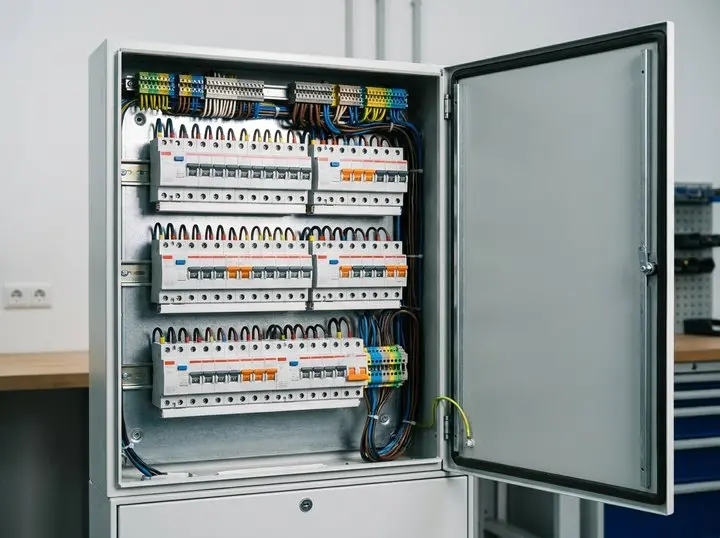
An individual supply might contribute a fraction of a milliamp, comfortably inside its limit. Leakage from units sharing a supply circuit adds, so a cabinet full of them can total tens of milliamps. A 30 mA residual-current device may then trip at switch-on, or sit close enough to its threshold to trip unpredictably later — the classic fault that only appears once the installation is fully populated.
Designing around it
- Add up the figures at design time from the datasheets, rather than discovering the total on site.
- Split across several RCD-protected circuits instead of one, so no single device sees the whole total.
- Check the earth connection is sound and permanent. Leakage current is only safe because it has a low-impedance path home; a high-integrity earth may be required above certain limits.
- Watch the inrush interaction. Filter capacitors also produce a brief surge to earth at switch-on that can trip a device the steady-state total would not.
Where the limits are tighter
Medical equipment is the obvious case: standards for medical electrical equipment set considerably lower permitted patient and enclosure leakage than general equipment, which is one reason a medically approved supply is not simply a relabelled industrial one.
Specifying for a populated cabinet or a medical application? Send us the load list and we will check the totals with you.