
Switching vs Linear Power Supplies
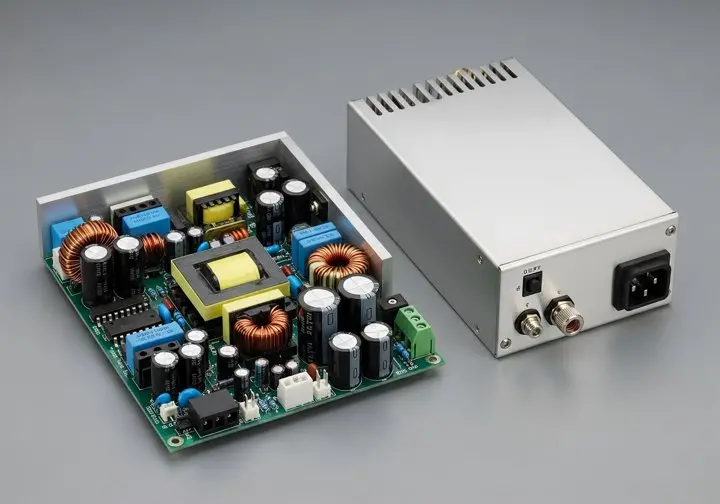
Switching and linear are the two classic approaches to producing a regulated DC output. They arrive at the same place - a clean, stable rail - but by very different routes, and that difference drives efficiency, size, cost and noise.
How they differ
A linear supply drops the excess voltage across a pass transistor that behaves like a variable resistor. Simple and quiet, but the surplus energy is burned off as heat. A switching supply instead chops the input at tens or hundreds of kilohertz, transforms it, then rectifies and filters - moving energy in packets rather than dissipating it.
- Efficiency - switching typically reaches 85–95%; a linear regulator can waste more than half its input as heat when the drop is large.
- Size & weight - high-frequency operation shrinks the magnetics, so switchers are far smaller and lighter for the same power.
- Noise & ripple - linear supplies are extremely quiet; switchers add high-frequency switching ripple that may need filtering.
- Cost - switchers win on cost-per-watt at higher powers; small linear designs stay cheap and simple.
Where each still wins
For anything mains-powered at real power levels - industrial, IT, LED, general equipment - switching is the default: efficient, compact and cool-running. Linear still earns its place where ultra-low noise matters more than efficiency: sensitive analogue, audio, precision measurement and lab bench rails. Many designs even combine the two, using a switcher for the heavy lifting and a small linear stage to polish the final rail.
Nearly all of our stock is modern high-efficiency switching. Browse our AC/DC range, or tell us your requirements and we may be able to recommend a suitable solution.