Surges and Transients: What EN 61000-4-5 Asks of an Input
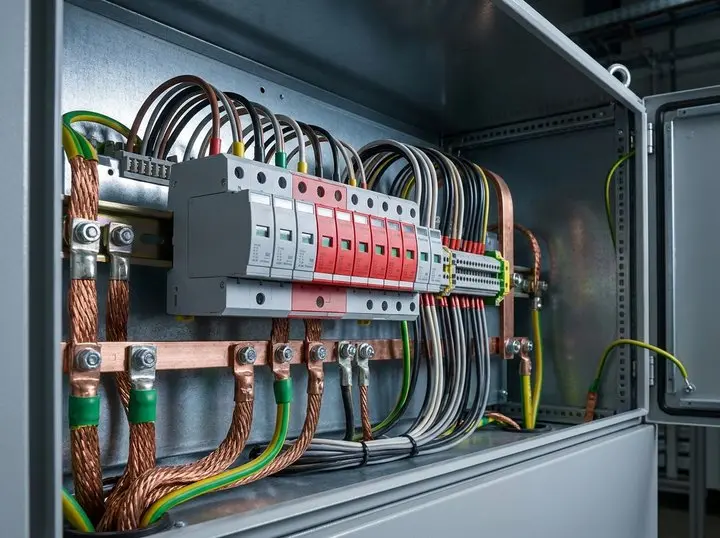
Mains and long DC runs carry transients: switching events, fault clearance elsewhere on the network, and the indirect effects of lightning. Immunity testing applies a standardised pulse to see whether equipment survives and keeps working.
What the test actually does
A surge generator applies a short, high-energy pulse of defined shape between lines, and between each line and earth. The level is chosen for the intended environment, and results are graded by performance criteria: whether the unit continued normally, recovered by itself, or needed intervention. That distinction matters — a supply that survives but drops its output has still passed at a lower criterion, and your system will see a reset.
Why compliance is not the whole answer
- The test level reflects an assumed environment. An exposed rural feed or a long external cable run can exceed it.
- Line-to-earth and line-to-line pulses behave differently, and an installation may be much more exposed to one than the other.
- Repeated surges age suppression components. A varistor that has absorbed years of transients degrades quietly, and can eventually fail short.
Practical measures
Fit surge protection at the origin of the installation, and again locally where a cable enters the enclosure after a long or external run. Keep the earth path short and low impedance — a suppressor is only as good as the connection carrying the energy away. Where a nuisance shutdown is expensive, choose a supply that recovers automatically rather than one that latches off.
Working in an exposed installation? Tell us the environment and we will help you choose accordingly.