
Isolation Ratings: Working Voltage, Test Voltage and Insulation
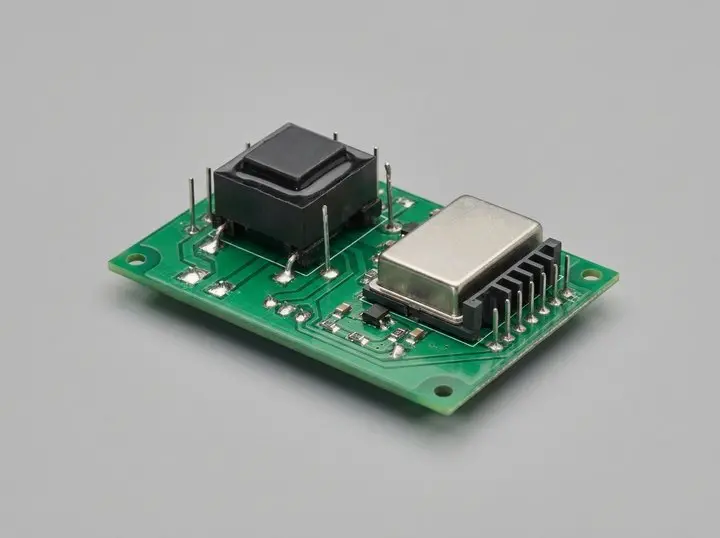
Isolation is one of the most frequently misread specifications on a DC-DC converter, because the headline number is a type test and not an operating rating.
Test voltage
A figure such as 1500 V or 3000 V is normally a dielectric strength test: the barrier withstood that voltage for a stated time, commonly one minute, without breaking down. It proves the insulation is sound. It says almost nothing about what the part may sit at continuously, and repeating the test unnecessarily stresses the barrier.
Working voltage
The working voltage is the potential the barrier may hold indefinitely in service. It is far lower than the test figure and it is the number your design must respect. If it is not stated, that is a question worth asking before you specify the part.
Functional, basic and reinforced
- Functional isolation exists to make the circuit work — it is not a safety barrier and must not be relied on for protection against shock.
- Basic insulation is a single layer of protection, and needs something else, such as an earthed enclosure, to be safe after a single fault.
- Reinforced insulation is specified to remain safe on its own after a single fault, and is what a barrier between mains and an accessible circuit generally needs.
Two parts with identical test voltages can fall into different classes, so the class — not the kilovolts — is what determines whether a converter is acceptable in a safety-critical position.
The rest of the barrier
Isolation is also a matter of physical separation. Creepage and clearance distances must be maintained across the converter and on your board beneath it, and pollution degree and altitude both affect the required distances. Routing a track under an isolated module is an easy way to undo its rating.