
Fanless or Fan-Cooled? Choosing on Noise, Life and Maintenance
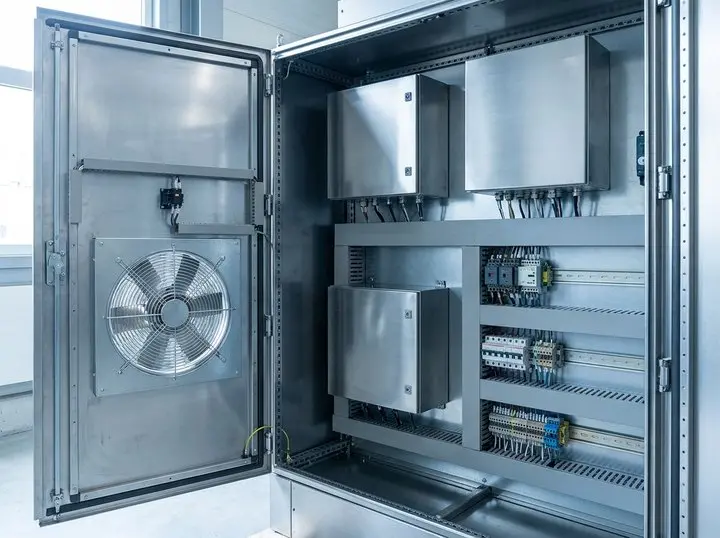
For most output powers you can buy either a convection-cooled supply or a smaller fan-cooled one. The electrical specification may be near identical. The decision is about where the unit lives and who has to look after it.
The case for fanless
- Nothing to wear out. A fan is a mechanical part with a bearing life, and it is normally the first thing in a supply to fail.
- No noise. Essential in offices, laboratories, patient areas and AV installations.
- No filter to service. Fans pull dust in. In a dusty or fibrous environment that becomes a maintenance schedule, and a blocked filter causes overheating.
- Sealed enclosures. If the box has to keep water and dirt out, moving air through it is not an option.
The case for a fan
Forced air moves far more heat than natural convection, so a fan-cooled supply delivers more watts from a smaller case and usually holds full output to a higher ambient temperature. Where space is tight and the environment is clean and already noisy — a rack room, a machine cabinet — that is often the better engineering answer.
The middle ground
Two options avoid the straight choice. Baseplate-cooled units conduct their heat into the panel or chassis they bolt to, giving high density with no moving parts, provided you give them real metal to sink into. Alternatively, choose a fanned unit generously derated so the fan is only needed at the extremes.
Whichever you pick, check the derating curve at your actual ambient.