
External Adaptor or Built-In Supply? Weighing the Trade
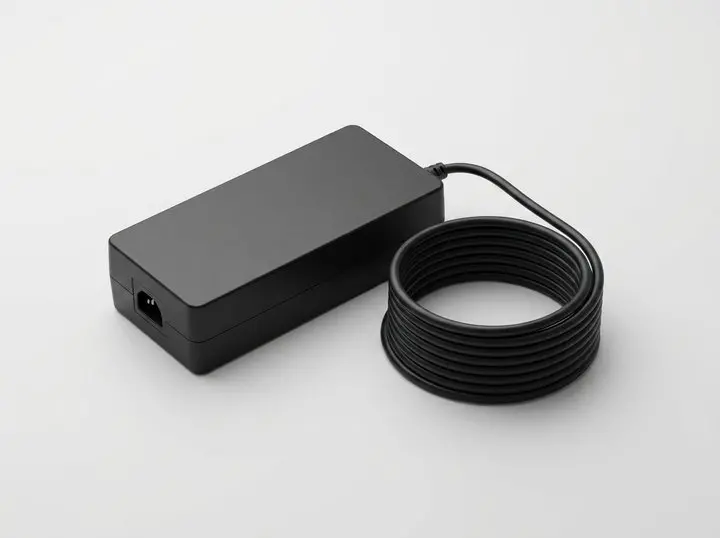
For equipment up to a couple of hundred watts you usually have a genuine choice: an external adaptor on a lead, or a supply built into the product. The decision reaches much further than the bill of materials.
What an external adaptor gives you
- The mains stays outside your enclosure. Your product handles only low voltage, which simplifies its safety assessment considerably.
- The heat stays outside too — often the deciding factor in a small sealed housing.
- Regional variants are somebody else’s problem. One product, a different adaptor or plug per market.
- Field replacement is trivial. A failed adaptor is swapped by the customer without opening anything.
What it costs you
There is a loose item to lose, specify and stock. Desk clutter and cable strain become real support issues. You also inherit a connector: barrel jacks vary in size and polarity, and an under-specified one is a common intermittent fault. And you have moved a voltage drop into a lead, which matters at higher currents.
Where built-in wins
Rack equipment, machinery and anything installed rather than plugged in are usually better with an internal supply — a single mains inlet, nothing to misplace, and full control over cooling and cable routing. The trade is that mains inside your enclosure raises the bar on creepage, earthing and the approvals you must hold.
The practical test
Ask who installs it, who services it, and whether the enclosure can get rid of the heat. Those three answers usually settle it faster than a cost comparison.