Earthing, Class I and Class II Explained
Almost every piece of mains equipment protects you from electric shock in one of two ways. Understanding the difference – and the little symbols that mark it – makes choosing and installing a power supply far simpler.
Protective earth and Class I
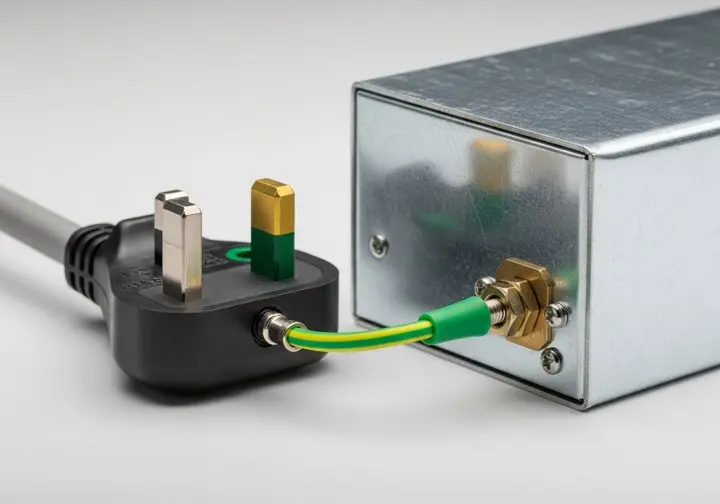
The protective earth (PE) is the third pin on a UK plug, wired in green-and-yellow. It bonds exposed metalwork – an enclosure, a chassis – back to the installation’s earth. If a live conductor ever touches that metal, the fault current has a low-resistance path to earth, which blows the fuse or trips the RCD before the surface can become dangerous. Equipment that relies on this is Class I: safety depends on both good insulation and a sound earth connection.
Class II and double insulation
A Class II product takes a different route. Instead of an earth, it uses two independent layers of insulation (basic plus supplementary, or reinforced insulation) so that a single failure still cannot make any touchable part live. No earth is needed, so these often appear on two-pin plug-tops. Look for the double-square symbol – one square inside another.
- Class I – earthed metal enclosure; needs the PE connection · typical of larger enclosed and DIN-rail supplies.
- Class II – double insulated, no earth pin · common on plug-top and desktop adaptors.
- Touch (leakage) current – the tiny current that flows through EMC filtering; keep it within limits, especially where many units share a circuit.
Match the class to the job: earthed metal-bodied supplies for panels and cabinets, double-insulated adaptors where an earth is impractical. Browse our AC/DC range, or tell us your requirements and we may be able to recommend a suitable solution.