
Constant-Voltage vs Constant-Current: Driving LEDs
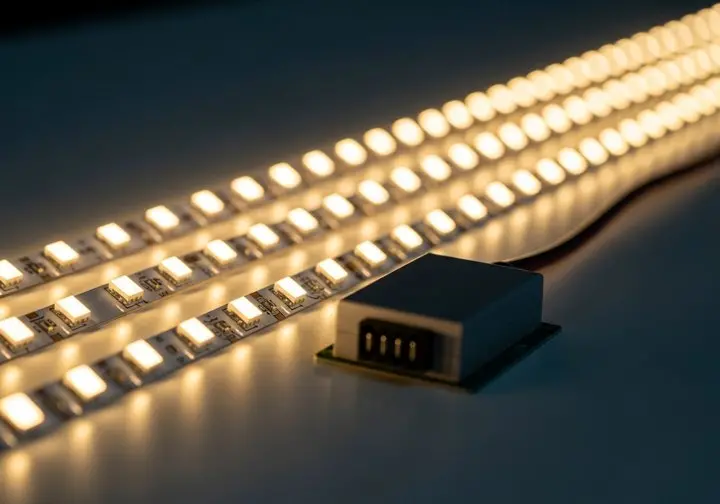
An LED is a current-driven device: its brightness follows the current through it, and a tiny lift in forward voltage can cause a large jump in current. Drive it from a plain fixed-voltage rail and small differences between devices — or a warm junction — can send the current running away. That is why LED supplies come in two flavours, and picking the right one matters more than the headline wattage.
Constant voltage vs constant current
A constant-voltage (CV) driver holds a fixed output — commonly 12 V or 24 V — and each load limits its own current, usually with an on-board resistor or a small regulator per module. A constant-current (CC) driver instead holds the current steady (say 350 mA, 700 mA or 1 A) and lets its voltage float within a rated window to suit the string.
- Constant voltage — LED strip, sign modules and anything built for a fixed rail; easy to parallel, cut and extend.
- Constant current — high-power emitters, COB arrays and downlights wired in series, where consistent current means consistent brightness and life.
- Check the window — a CC driver only regulates between its minimum and maximum output voltage, so the string must sit inside that range.
Getting the match right
Confirm whether your fitting expects a voltage or a current, then size for headroom and dimming. LED loads run cooler and last longer with a little margin, and if you need dimming, choose a driver whose method — mains-edge, 0–10 V or PWM — matches your controls. Get the type right first; the rest is detail.
Tell us your requirements and we may be able to recommend a suitable solution, or browse our AC/DC power supplies.